
How Clear Aligners Are Made in 2026: The Technology Behind Your Custom Trays and Why Precision Matters
Clear aligners may look simple, but every tray is the result of digital scanning, treatment planning, manufacturing, trimming, and quality control. Understanding how clear aligners are made in 2026 shows why accuracy at every stage matters.
The clear aligner manufacturing process 2026 usually begins with a detailed digital model of the patient’s teeth.
Step 1: Creating a Digital Scan
The first step in how custom aligner trays are created is capturing the exact shape and position of the teeth and gums.
The clinician reviews the scan along with the patient’s bite, photographs, dental history, and, when appropriate, other diagnostic records.
This is one reason how clear aligners are made in 2026 is closely connected to digital dentistry. Invisalign, for example, uses detailed 3D intraoral scanning as the basis for customized treatment planning.
Step 2: Planning Tooth Movement Digitally
Specialized orthodontic software is used to create a treatment plan. Teeth are digitally moved from their starting positions toward the desired result in carefully staged increments. The clinician reviews and approves the plan before manufacturing begins.
The clear aligner manufacturing process 2026 therefore involves more than automatically printing a series of trays. Clinical judgment determines which teeth should move, in what sequence, and how attachments or other features may help deliver controlled forces.
Advanced software can also provide a visual simulation of anticipated treatment progress. However, the simulation is a plan, not a guarantee, because real teeth and biological tissues may respond differently. Modern systems use digital algorithms to stage tooth movements and help clinicians customize treatment.
Step 3: 3D Printing and Thermoforming
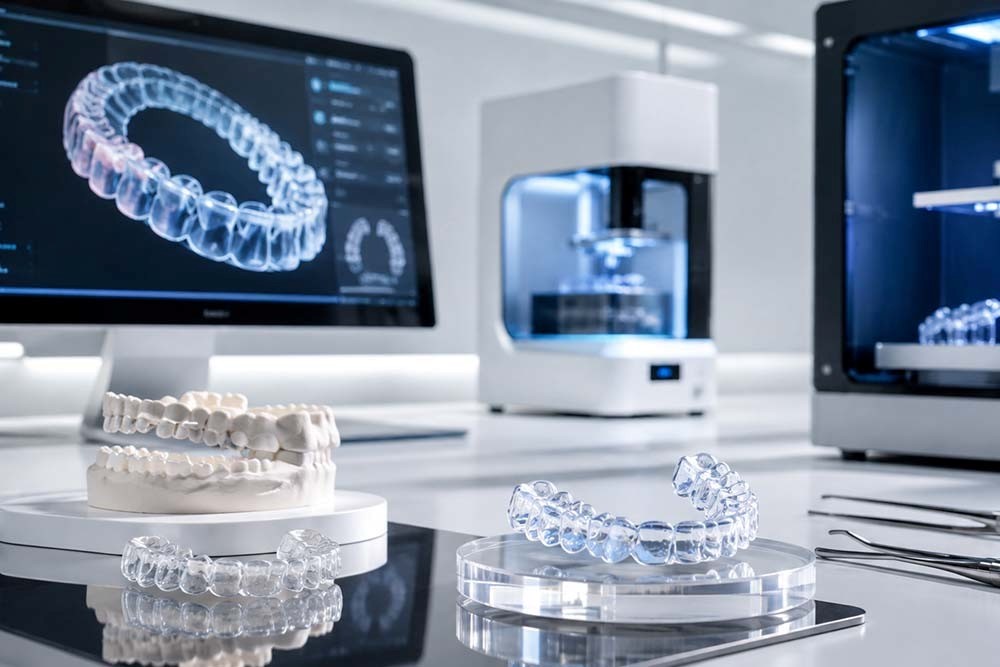
The phrase 3D printed aligners technology 2026 can be confusing. In many established manufacturing workflows, the aligner itself is not directly printed. Instead, a separate 3D model is printed for every planned stage of tooth movement. A clear thermoplastic sheet is then heated and pressure-formed or vacuum-formed over that model.
After forming, technicians separate the plastic tray from the model, trim it to the desired gumline, smooth its edges, clean it, and perform quality checks.
This conventional method remains a major part of how custom aligner trays are created. Formlabs describes a workflow involving scanning, digital design, printing sequential dental models, thermoforming, cutting, finishing, and quality control.
Are Aligners Ever Printed Directly?
Yes. Direct 3D-printed aligner technology in 2026 is now a real manufacturing pathway for certain systems and materials. Instead of printing a model and thermoforming plastic over it, specialized light-curing resins can be used to print the aligner itself.
The technology is developing rapidly, but direct printing is not automatically the manufacturing method used by every aligner brand or dental practice. Material approval, printer compatibility, post-processing, clinical validation, and regulatory requirements all matter.
For patients, the important point is that 3D printed aligners technology 2026 can describe either 3D printing within the broader manufacturing workflow or, in some systems, direct printing of the final appliance.
Why Precision Matters
Precision determines whether a tray fits the intended treatment stage. Each aligner should correspond closely to the digital plan so it can apply controlled force in specific areas.
In the clear aligner manufacturing process in 2026, inaccuracies may arise from scanning, digital design, model printing, thermoforming, trimming, or material behavior. Quality control helps identify trays with defects or poor fit before they reach patients.
Understanding how custom aligner trays are created also explains why professional monitoring remains important. A clinician can check tracking, attachments, bite changes, oral health, and whether refinements are needed.
How Many Trays Are Needed?
There is no universal number. A mild case may require fewer trays, while more complex movement can require dozens and sometimes additional refinement aligners. The total depends on the treatment plan, movement required, aligner-change schedule, and how closely the teeth track the planned positions.
This variability is another reason how clear aligners are made in 2026 should be viewed as an individualized process rather than a standardized package.
FAQ’s
Q1. How are clear aligner trays made to fit your teeth exactly?
A: A digital scan creates a three-dimensional model of your teeth. Treatment software then produces staged positions, and customized aligners are manufactured for those stages. Precision scanning, accurate design, manufacturing controls, and clinical checks help produce a close fit.
Q2. What technology is used to design clear aligners in 2026?
A: Modern systems use intraoral scanners, 3D imaging, orthodontic CAD software, treatment-planning algorithms, digital simulations, 3D printers, and either thermoforming equipment or direct-printing systems.
Q3. How many aligner trays are typically included in a full treatment?
A: There is no fixed number. Some patients need relatively few stages, while others need dozens of trays or additional refinements. Case complexity and the clinician-approved treatment plan determine the final sequence.
Q4. Is 3D printing used to make clear aligners?
A: Yes. Many workflows 3D print sequential dental models and thermoform aligners over them. Some newer systems can directly 3D print the final aligner using specialized materials. The method depends on the manufacturer, technology, and prescribed treatment.

Leave a Reply